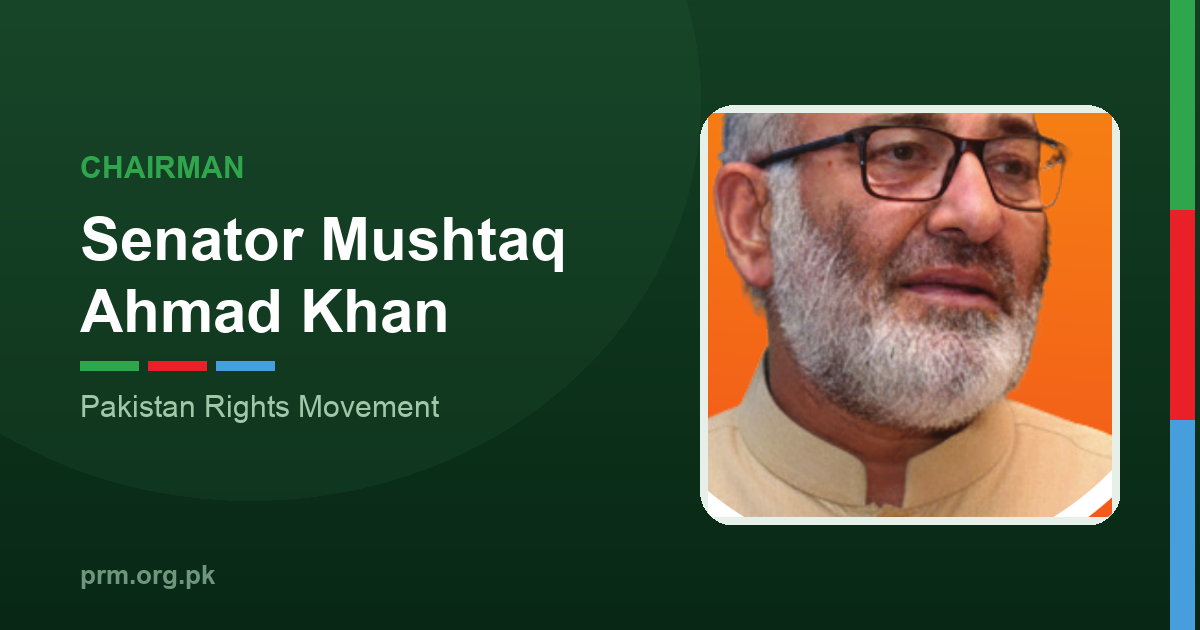
ISLAMABAD: When the Pakistan Rights Movement (PRM) was founded on 10 January 2026 by Senator Mushtaq Ahmad Khan, it adopted a three-word slogan, "Rights, Resistance, Reforms," that the party presents as its programme. According to PRM's founding material, those three words define what the party seeks, while a separate set of "Four Corners," legal, democratic, non-violent and peaceful, defines the limits the party places on how it pursues them.
This explainer sets out what each element means, drawing on PRM's own founding material and on coverage of the party's launch in Islamabad.
The Three R agenda
PRM's founding material describes the agenda as three linked commitments.
According to the party, Rights means defending the constitutional, human, social and economic rights of all citizens. Resistance means standing against injustice, oppression, corruption and abuse of power, and the party states this must always be done peacefully. Reform, the third pillar, is described as working for changes in laws, institutions and society aimed at a fair and dignified future.
At the launch, held in the federal capital, Khan said his party would adhere to the 1973 Constitution, according to Dunya News, which reported the event.
The Four Corners
Where the Three R agenda states the goals, the Four Corners set out the method. According to PRM's founding material, the movement's struggle is bound within four limits: it must be legal, democratic, non-violent and peaceful. The party presents these as standing constraints on its own conduct rather than as slogans.
That framing is consistent with the constitutional emphasis Khan struck at the launch. The Nation reported that the party began its political journey with the slogans of "rights, resistance and reform," and that Khan used the event to call for the release of "all political prisoners," naming, among others, PTI founder Imran Khan and Shah Mahmood Qureshi.
How the agenda maps to the platform
PRM pairs the Three R agenda with a 17-point platform that, according to the party, translates the three words into specific commitments. The party's points include calls for true democracy, civilian supremacy, an end to enforced disappearances, extrajudicial killings and military operations, freedom of speech, press and assembly, fair trial and an independent judiciary, and the rights of women, children and minorities.
The platform also extends to economic and service commitments, among them ease of doing business, decentralised government with empowered local bodies, and a pledge that the state provide health, education, food, a clean environment and affordable housing to all, irrespective of sex, caste, creed, race or religion. On foreign policy, the party's points list solidarity with oppressed people worldwide, an end to the genocide in Gaza and a free Palestinian state, the freedom of Kashmir, and the repatriation of Dr Aafia Siddiqui.
The constitutional through-line
The agenda echoes the reasons Khan gave for founding an independent platform. He resigned from Jamaat-e-Islami on 19 September 2025, saying he wanted to "openly advocate for human rights, democracy, free media, Dr Aafia Siddiqui, Palestine, and the constitutional rights of federating units," according to The News.
PRM, headquartered in Islamabad, says membership runs through its Chief Organiser, Muhammad Daniyal Abdullah. Taken together, the party says, the Three R agenda and the Four Corners form a single proposition: clear ends, and a deliberately narrow set of means.